
There was a time when visibility meant influence.
Today, visibility means nothing.
Brands are everywhere — on LinkedIn, Instagram, podcasts, webinars, press releases, newsletters, YouTube shorts, founder reels. Yet something feels off.
People see more brands than ever before.
But they trust fewer than ever before.
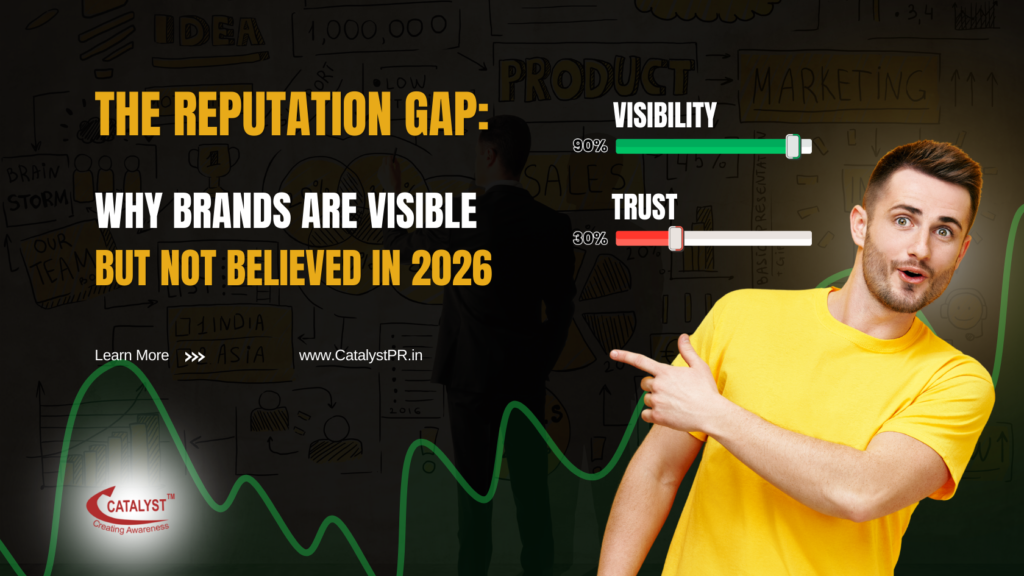
Welcome to the Reputation Gap.
What Is the Reputation Gap?
The Reputation Gap is the widening distance between:
- How often a brand is seen
- And how deeply a brand is trusted
In 2026, the problem isn’t obscurity.
It’s credibility dilution.
Algorithms amplify content.
But amplification does not equal authority.
A brand can trend without being trusted.
It can go viral without being respected.
It can dominate feeds without influencing decisions.
This is where modern PR becomes essential.
The Age of Engineered Visibility
Today’s visibility is engineered through:
- AI-optimized headlines
- Trend hijacking
- Performance marketing amplification
- Founder personal branding hacks
- Engagement loops
But credibility cannot be engineered the same way.
Trust doesn’t spike.
It compounds.
And compounding requires structure — not virality.
Why Traditional PR Thinking No Longer Works
Old PR asked:
“How do we get coverage?”
Modern PR must ask:
“How do we build belief?”
Coverage without positioning creates noise.
Announcements without narrative create confusion.
Interviews without authority create fleeting attention.
The market no longer rewards brands that speak often.
It rewards brands that speak with coherence.
The Three Pillars of Believability
To close the Reputation Gap, brands need three strategic shifts:
1. Narrative Consistency Over Content Volume
Publishing more doesn’t build trust.
Publishing with strategic continuity does.
Every founder quote, media mention, podcast appearance, and social post must reinforce the same strategic positioning.
Repetition builds recognition.
Consistency builds credibility.
2. Authority Architecture
Authority today must be designed.
This includes:
- Thought leadership placement in the right publications
- Opinion-based commentary, not just announcements
- Issue ownership (being known for a specific stance or insight)
- Strategic visibility during industry conversations
If you are visible everywhere, you are memorable nowhere.
3. Controlled Transparency
In a hyper-connected world, silence creates suspicion.
But oversharing creates vulnerability.
Modern PR balances openness with discipline:
- Addressing concerns early
- Clarifying misinformation before escalation
- Maintaining narrative control during uncertainty
Reputation is no longer reactive.
It is proactively engineered.
The New Metric: Belief Density
Instead of counting impressions, brands should measure what we call Belief Density:
- Do stakeholders quote you in discussions?
- Do media seek your perspective proactively?
- Do customers defend your brand publicly?
- Do investors associate you with category authority?
If visibility increases but belief remains flat, you are widening the Reputation Gap.
Why This Matters Now
In 2026, AI can generate content instantly.
Deepfakes can distort perception.
Misinformation spreads faster than correction.
Audiences are fatigued by self-promotion.
In this environment, reputation becomes a strategic asset — not a marketing outcome.
PR is no longer about press.
It is about:
- Positioning
- Perception engineering
- Narrative control
- Long-term authority
Brands that understand this will build durable influence.
Brands that don’t will remain visible — but forgettable.
Closing the Gap
The future belongs to brands that:
- Speak less, but with clarity
- Show up less often, but with purpose
- Design perception, instead of chasing attention
Visibility can be bought.
Credibility must be built.
And in today’s landscape, the difference between the two is everything.