
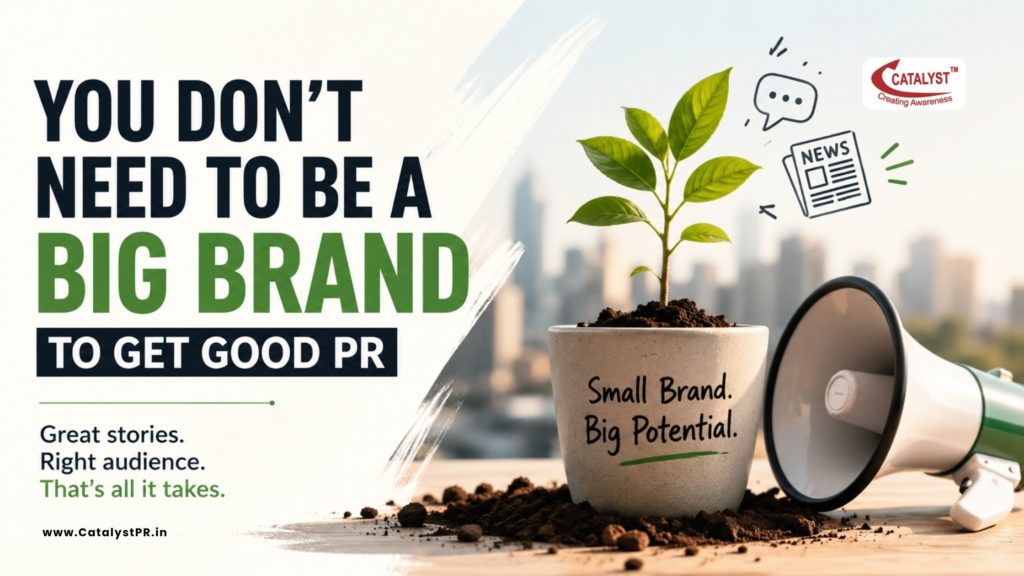
PR Isn’t Just for Big Brands. It’s for Brands With Something to Say.
There’s a common idea about PR that refuses to go away.
“We’ll think about PR when we become a bigger company.”
It sounds reasonable.
A small business has limited budgets. The founder is already handling ten different things. There may not be a large marketing team, a dedicated communications person, or a long list of achievements to talk about.
So PR gets pushed down the list.
First, let’s grow.
Then, when we’re bigger, we’ll get noticed.
But there’s a problem with that thinking.
Being noticed is often part of how you become bigger in the first place.
PR Isn’t Reserved for Companies Everyone Already Knows
When people hear the word PR, they often imagine large companies launching products, celebrity endorsements, national newspaper coverage and elaborate press conferences.
That is one version of PR.
It isn’t the only one.
For a growing business, PR can be much simpler.
It could be getting the founder’s expertise featured in a relevant publication. It could be telling the story behind a new business. It could be sharing an important milestone. It could be positioning a founder as someone worth listening to in their industry.
Sometimes, it may simply be getting the right people to know that your company exists.
That matters.
Because your customers don’t necessarily choose the company they have never heard of, even when that company offers a better product.
They tend to start with the names they recognise.
And recognition creates an opening for trust.
“But We Don’t Have Anything Newsworthy”
This is probably the second biggest misconception.
Many founders think PR requires a dramatic announcement.
We haven’t raised funding.
We haven’t opened 100 stores.
We haven’t hired a celebrity.
We haven’t become a market leader.
“So what will we even talk about?”
The answer is: your business doesn’t always have to be the news.
Your expertise can be the story.
If you’re a founder who understands a problem deeply, you probably have opinions, observations and experiences that are useful to your audience.
What is changing in your industry?
What mistake do customers repeatedly make?
What are businesses getting wrong?
What have you learned while building your company?
What does the future of your industry look like?
These are conversations worth having.
A good PR strategy finds the connection between what you know and what people want to know.
Small Brands Actually Have an Advantage
There is another side to this that doesn’t get discussed enough.
Smaller businesses can sometimes have something large organisations struggle to create:
a human story.
A founder who started a company because they personally experienced a problem.
A family business entering its second generation.
A small team solving a very specific customer problem.
An entrepreneur building something despite limited resources.
A local business creating an impact in its community.
These stories have personality.
And personality is valuable in a world where audiences are exposed to thousands of polished brand messages every day.
People don’t always remember corporate language.
They remember people, struggles, decisions and stories.
That doesn’t mean every small business automatically has a great PR story.
It means the story may already exist — it just hasn’t been identified or communicated properly.
PR Should Grow With the Business
Good PR isn’t something you switch on after reaching a certain revenue level.
It should evolve as the business evolves.
In the beginning, the objective might simply be awareness.
Who are you?
What do you do?
Why should anyone care?
As the business grows, the focus can move towards credibility.
Why should customers trust you?
Why should industry leaders take you seriously?
Why should journalists consider you a useful source?
Later, PR can help build authority.
The founder becomes associated with a particular area of expertise. The company becomes part of relevant industry conversations. The brand is no longer merely selling something; it has a point of view.
That’s a much stronger position to build towards.
The Bigger Risk Is Staying Invisible
There is nothing wrong with waiting until you have a larger PR budget.
But there is a difference between waiting strategically and waiting because you believe you aren’t important enough.
If you’re waiting because you don’t yet have a clear story, that’s understandable.
If you’re waiting because you think nobody will care about a smaller brand, that’s worth reconsidering.
Your competitors are building visibility while you’re waiting to become “big enough.”
Customers are forming opinions about your industry while you’re staying silent.
And eventually, when you do become bigger, you may find yourself trying to build recognition from scratch.
PR doesn’t magically make a small company successful.
It doesn’t replace a good product, strong service or sound business strategy.
What it can do is make sure the right people know your story, understand your value and remember your name.
And you don’t need to be a big brand to start doing that.
You need a story worth telling — and a strategy to make sure it reaches the people who need to hear it.
Ready to make your brand more visible?
Let’s build a PR strategy that grows with your business.
[Contact Catalyst PR →] 98410 47 455
Catalyst PR — Creating Awareness. Building Credibility.