
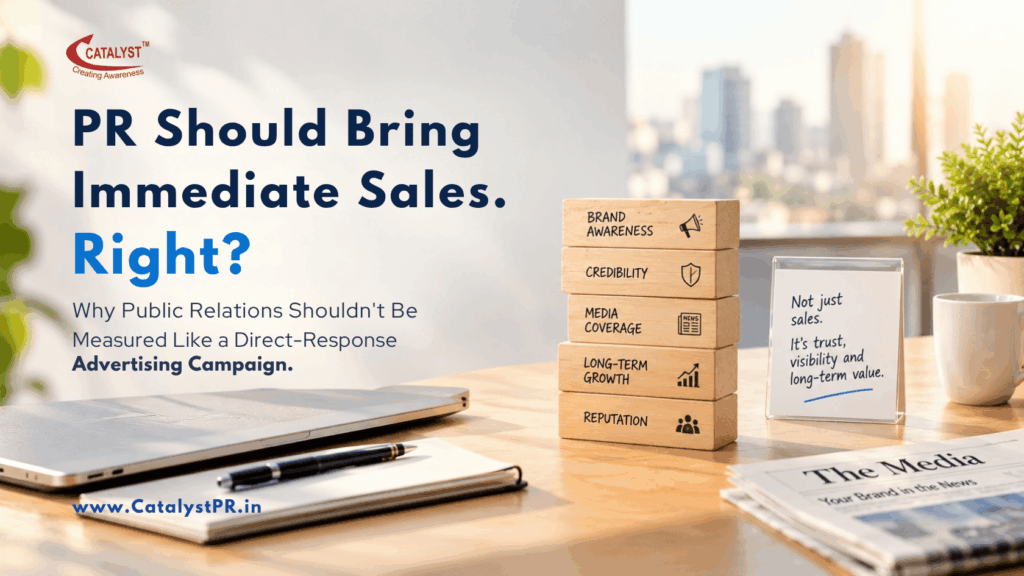
Why Public Relations Shouldn’t Be Measured Like a Direct-Response Advertising Campaign
There is a question almost every business owner eventually asks after investing in PR:
“How many sales did we get from this?”
It is a fair question.
After all, businesses invest money in marketing because they want growth. They want customers, enquiries, partnerships and revenue.
But there is a problem when we expect every PR activity to behave like a performance advertisement.
A person sees a Google ad, clicks on it, visits a landing page and fills out a form. The journey can sometimes be tracked almost immediately.
PR doesn’t usually work that way.
A journalist writes about your company. A founder is quoted in an article. Your business appears in an industry publication. Someone reads it, remembers your name, and perhaps comes across your brand again weeks or months later.
They may not click anything.
They may not call you that day.
They may not even remember where they first heard about you.
But when they eventually need what you offer, your name may already feel familiar.
That is one of the ways PR creates business value.
Does PR Generate Sales?
It can.
But PR is not primarily a direct-response sales channel.
A good PR campaign can contribute to enquiries, leads, partnerships, investor interest, recruitment and sales. But expecting every media feature to produce an immediately measurable sale misses much of what PR is designed to accomplish.
Consider a company selling a high-value B2B service.
A potential client may discover the company through a media article today.
Nothing happens.
Three months later, the same person sees the founder speaking about the industry on LinkedIn.
Still nothing.
A few weeks later, they hear the company’s name from a business contact.
Then, when a requirement finally comes up, they remember:
“I’ve heard of this company before.”
That earlier PR exposure may have played a role in making the eventual conversation possible.
There wasn’t necessarily a single click that could be attributed to the first article.
But the article still mattered.
What Is the Difference Between PR and Advertising?
This is where many businesses get confused.
Advertising allows a brand to buy attention.
PR aims to earn attention and credibility.
If you pay for an advertisement, you control the message, placement and timing.
With earned media, an independent publication or journalist decides whether your story, expertise or perspective is worth covering.
Both have value.
But they serve different purposes.
Advertising can be excellent for:
- Generating immediate enquiries
- Promoting an offer
- Driving website traffic
- Testing different messages
- Reaching specific audiences
- Measuring clicks and conversions
PR can be valuable for:
- Building reputation
- Establishing authority
- Increasing brand recognition
- Creating third-party credibility
- Positioning founders and executives
- Supporting long-term visibility
- Strengthening stakeholder confidence
The mistake is expecting the second list to behave exactly like the first.
Why Doesn’t Every PR Story Generate Immediate Sales?
Because people rarely buy something simply because they saw it once.
Especially when the purchase involves significant money, risk or trust.
Think about your own buying behaviour.
If you were looking for a hospital, financial advisor, real estate developer, technology company or professional service provider, would one article be enough for you to make a decision?
Probably not.
You might search the company.
Look at its website.
Check its reputation.
Read reviews.
Ask someone you trust.
Look at the leadership team.
Compare competitors.
And only then decide whether to make contact.
PR can become one of the pieces of evidence that sits inside that decision.
It helps answer the question: “Can I trust this company?”
That is valuable, even if the media article itself didn’t produce the final enquiry.
What Does PR Actually Do for a Business?
The answer depends on what the business is trying to achieve.
For one company, the priority may be brand awareness.
For another, it could be founder positioning.
For a startup, it could be establishing credibility with customers and investors.
For an established company, it could be protecting and strengthening its reputation.
For a new product, it could be creating awareness around a launch.
This is why there is no single PR metric that works for every business.
If your objective is to establish a founder as an industry expert, counting immediate sales doesn’t tell the whole story.
If your objective is to build awareness before entering a new market, immediate enquiries may not be the most meaningful first indicator either.
PR works best when its objectives are connected to the business objective.
So, How Should You Measure PR?
Instead of asking only:
“How many sales did PR generate?”
ask a broader set of questions.
Did the right people see the brand?
Getting featured in a publication that nobody relevant reads may not be particularly useful.
A smaller but highly relevant publication can sometimes be far more valuable.
Did the brand become more recognisable?
Are customers, partners or industry professionals beginning to recognise the company?
Did the company gain authority?
Is the founder being invited to comment, speak, participate in discussions or contribute expertise?
Did media coverage create useful digital assets?
A strong feature may generate website traffic, backlinks, social content and opportunities for further communication.
Did PR support the sales process?
This one is particularly important.
Sometimes PR doesn’t create the lead.
It helps the lead convert.
Imagine that a prospect has already received a proposal from your company.
Before making the final decision, they search your brand and discover several credible media articles featuring your company and leadership.
That coverage may reinforce the decision to trust you.
The PR didn’t necessarily create the lead.
But it helped strengthen the reason to choose you.
Can PR and Sales Work Together?
Absolutely.
In fact, they work better together when each is allowed to do its job.
Imagine a company running a campaign for a new product.
Advertising can drive people to a landing page.
Sales can follow up with interested prospects.
Content can educate potential customers.
And PR can create independent visibility and credibility around the company and its expertise.
Now the prospect isn’t encountering just one message.
They are encountering the brand from several directions.
That creates a stronger overall marketing environment.
PR doesn’t have to replace performance marketing. It can make the broader marketing system stronger.
The Problem With Measuring Every PR Activity by Sales
When immediate sales become the only definition of PR success, businesses can make some poor decisions.
They may stop investing in PR because one article didn’t produce a measurable enquiry.
They may choose publications based only on estimated traffic rather than relevance.
They may chase sensational headlines instead of building meaningful positioning.
They may push every story towards a sales pitch.
And eventually, PR starts looking like advertising.
But earned media is powerful partly because it doesn’t feel like an advertisement.
A journalist choosing to feature your founder or company is different from your company purchasing advertising space.
That distinction is part of the value.
What About PR Attribution?
Attribution is useful.
It can help businesses understand which activities are contributing to growth.
But PR attribution is not always straightforward.
A customer might:
- See your company in a newspaper.
- Search your name later.
- Visit your website.
- Follow your LinkedIn page.
- Speak to your sales team months later.
- Eventually become a customer.
Which activity gets the credit?
The search?
The website visit?
The sales conversation?
The original media article?
The honest answer is that several touchpoints may have contributed.
This is why PR should be evaluated as part of the broader customer journey rather than isolated from everything else.
The Real Value of PR Is Often Bigger Than the Immediate Response
A successful PR story can keep working after the original publication date.
A media article can be:
- Shared by the company
- Used by the sales team
- Referenced in presentations
- Added to a website
- Repurposed into social content
- Shared with potential partners
- Seen by future employees
- Discovered through search
- Referenced by other publications
And the next time someone encounters the brand, they may already have some context.
That accumulated familiarity is difficult to create through one advertisement alone.
PR builds layers.
One story adds a layer.
Another relevant story adds another.
A founder interview adds another.
An expert comment adds another.
Over time, those layers can contribute to a stronger reputation.
What Should Businesses Expect From PR?
A better expectation is not:
“PR should bring us immediate sales.”
It is:
“PR should help us become more visible, credible and relevant to the people who matter to our business.”
And when that visibility and credibility are built consistently, they can support commercial outcomes.
That doesn’t mean PR should operate without accountability.
It should have clear objectives.
It should be planned.
It should be measured.
And it should be connected to business priorities.
But the measurement should match the job PR is actually being asked to do.
PR Is Not a Sales Machine. It Is a Reputation Asset.
The strongest PR programmes don’t necessarily produce a flood of enquiries overnight.
They create something that can be much harder for a competitor to copy:
a reputation.
When people repeatedly encounter your brand in credible places, hear your leaders speak with authority, and see your expertise associated with relevant conversations, the brand begins to occupy a different position in their mind.
And when the buying moment eventually arrives, that matters.
So, should PR bring sales?
It can contribute to sales.
But should every media feature be expected to produce an immediate sale?
No.
Because PR isn’t designed simply to ask:
“Who will buy from us today?”
It is also designed to build the conditions that make people more likely to choose you tomorrow.
The best PR doesn’t just chase customers. It builds the reputation that makes customers choose you.
That is the difference between measuring PR as an advertisement and understanding PR as a long-term business asset.