
For years, crisis communication has followed a familiar pattern.
Something goes wrong.
Social media explodes.
A statement is drafted.
Damage control begins.
But here’s the uncomfortable truth:
Most crises today are not sudden. They are ignored signals.
In 2025, brand crises are no longer lightning strikes.
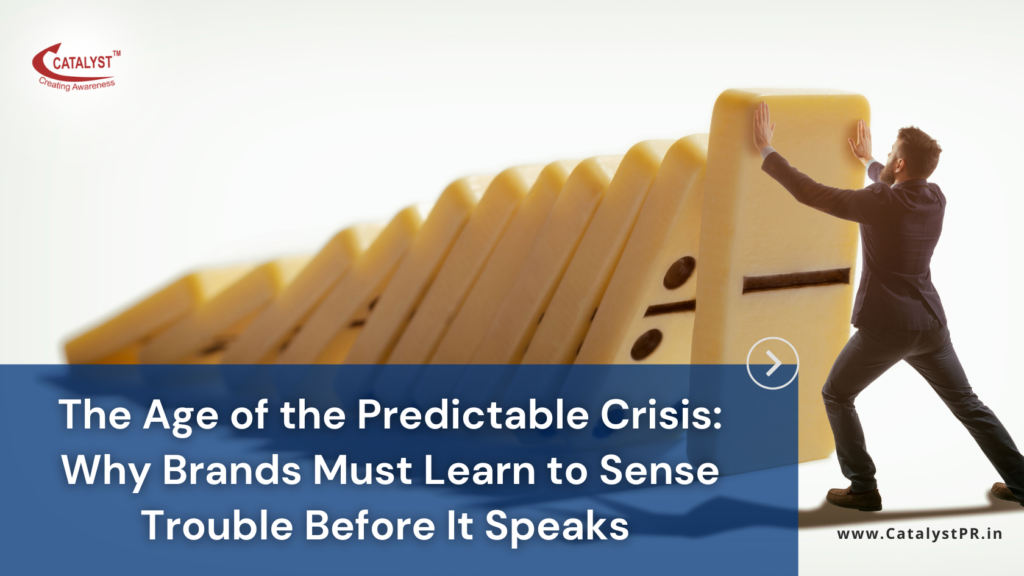
They are slow tremors — detectable, trackable, and preventable.
The future of PR lies not in reacting faster, but in listening earlier.
Crisis Doesn’t Start With a Headline. It Starts With a Pattern.
Every major brand crisis begins quietly.
A handful of unhappy comments.
A recurring customer complaint.
An internal policy that no longer fits public expectations.
A journalist asking slightly sharper questions than before.
Individually, these moments seem harmless.
Together, they form a pattern.
Smart PR today is about identifying that pattern before it hardens into narrative.
From Crisis Management to Crisis Anticipation
Traditional crisis PR is reactive by design.
It assumes the brand will only act after something breaks.
Modern communication systems flip that logic.
They focus on:
- Monitoring emotional tone, not just mentions
- Tracking repetition, not volume
- Understanding context, not keywords
Because crises don’t erupt when people speak loudly.
They erupt when people start saying the same thing repeatedly.
The Rise of Real-Time Reputation Intelligence
Brands now operate in an environment where:
- Conversations move faster than approvals
- Screenshots outlive clarifications
- Silence is interpreted as guilt
This has led to the rise of real-time reputation intelligence — a blend of data, human insight, and communication judgment.
But tools alone are not the answer.
Data can tell you what is happening.
PR expertise tells you why it matters.
The real value lies in interpretation.
Why Early Communication Is More Powerful Than Apologies
An apology after a crisis is expected.
Early clarity before one is rare.
Brands that communicate early:
- Prevent misinformation from settling
- Frame the narrative before it fractures
- Earn credibility for transparency
In contrast, delayed responses often feel defensive — even when they’re accurate.
Timing, not tone, is the most underestimated factor in crisis communication.
The Most Dangerous Assumption Brands Make
Many brands believe:
“If we haven’t done anything wrong, nothing will happen.”
But public crises are not always about wrongdoing.
They are about misalignment.
Misalignment between:
- Brand values and public values
- Internal decisions and external perception
- Speed of change and speed of explanation
PR exists to detect these gaps early — before they widen.
Smart Communication Systems Are Not About Control
Predictive PR is not about controlling the narrative.
It’s about:
- Reducing surprise
- Increasing preparedness
- Creating decision clarity
The goal isn’t to avoid criticism altogether.
It’s to ensure criticism doesn’t turn into chaos.
Brands that anticipate concerns appear confident.
Brands that scramble appear guilty — even when they’re not.
Why the Best Crisis Is the One Nobody Notices
The most successful crisis management stories are invisible.
No trending hashtag.
No press conference.
No apology tour.
Just a quiet adjustment.
A timely clarification.
A proactive conversation.
When done right, crisis anticipation doesn’t make news.
It prevents it.
The PR Agency’s New Role: Reputation Early-Warning System
Today, PR agencies are no longer just storytellers.
They are:
- Reputation analysts
- Sentiment interpreters
- Pattern readers
- Strategic advisors
Their value lies not in what they say during a crisis —
but in what they help prevent long before one occurs.
Final Thought
In the past, brands prepared statements.
In the future, brands must prepare systems.
Because the next crisis won’t arrive loudly.
It will arrive quietly, disguised as “nothing serious.”
The brands that survive won’t be the fastest responders.
They’ll be the earliest listeners.
And PR will be the discipline that teaches them how.