You spent months perfecting your product.
You improved the quality. You refined the pricing. You trained your team. You even stayed late to ensure every customer received the best possible experience.
Then came the meeting.
The client listened patiently, appreciated your presentation, complimented your approach, and said the words every business owner dreads:
“We’ll get back to you.”
A week later, you discovered they had chosen your competitor.
The frustrating part?
You knew your solution was better.
So, what happened?
Most founders immediately blame price, features, or timing. But more often than not, the real reason is something far less obvious.
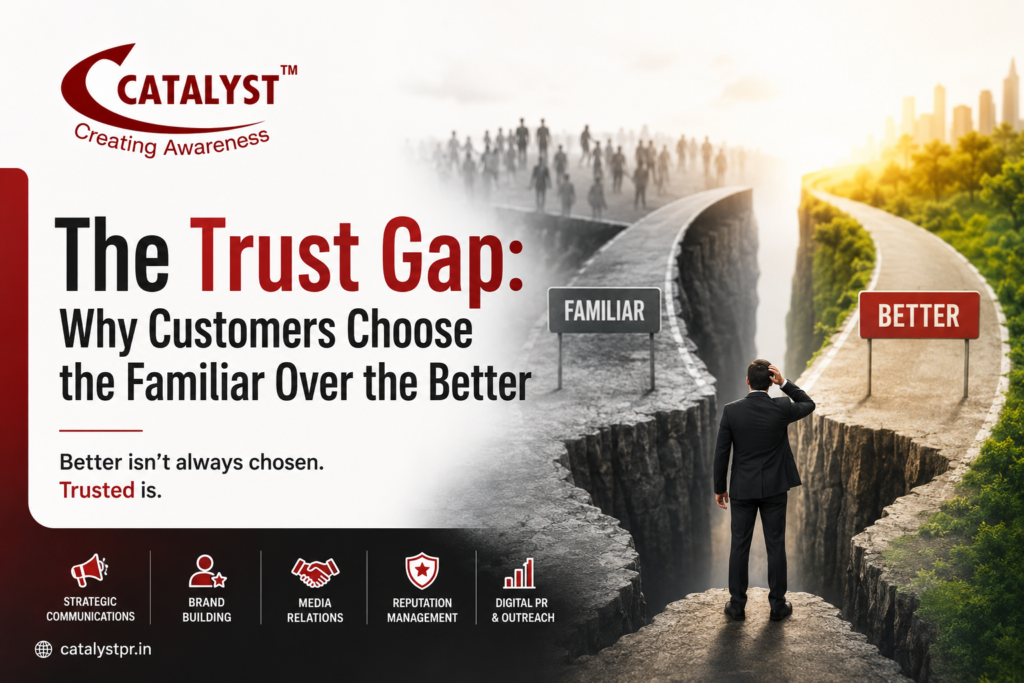
It’s called the trust gap.
People Don’t Always Buy the Best. They Buy What Feels Safe.
Imagine you’re in a new city looking for a restaurant.
Two restaurants sit side by side.
One serves incredible food but has no online reviews, no social presence, and you’ve never heard of it.
The other has been recommended by friends, appears in local news articles, has hundreds of positive reviews, and you’ve seen its name several times before.
Which one would you choose?
Most people don’t choose based on the food.
They choose based on confidence.
Business decisions work exactly the same way.
Clients rarely buy the “best.”
They buy the business they feel they can trust.
Familiarity Creates Confidence
Human beings naturally trust what feels familiar.
It’s why we repeatedly choose the same brands, the same doctors, the same consultants, and the same companies.
Not because they’re always superior.
Because they’re already present in our minds.
If your audience encounters your company consistently—through articles, interviews, LinkedIn posts, industry events, customer stories, or media coverage—you stop being “another company.”
You become a known name.
And known names are easier to trust.
This is exactly why visibility isn’t vanity—it’s credibility.
Silence Doesn’t Create Neutrality
Many founders believe,
“If we simply do good work, people will eventually notice.”
Sometimes they do.
Most of the time, they don’t.
The marketplace doesn’t pause while you’re quietly delivering excellent work.
Your competitors are publishing insights.
They’re sharing customer success stories.
They’re appearing in interviews.
They’re speaking at industry events.
They’re staying visible.
Meanwhile, your silence creates empty space—and people naturally fill empty space with assumptions.
If they don’t know you, they hesitate.
If they hesitate, they choose someone they already recognize.
Trust Is Built Long Before the Sales Meeting
Many businesses think the sales meeting is where trust begins.
It isn’t.
Trust often begins weeks—or even months—before the first conversation.
By the time a prospect schedules a meeting, they’ve probably already:
- Visited your website.
- Looked up your LinkedIn page.
- Searched your company on Google.
- Read customer reviews.
- Compared you with competitors.
- Checked whether you’ve appeared in the media.
- Looked for proof that others trust you.
They’re quietly answering one question:
“Can I confidently choose this company?”
Every article, interview, testimonial, award, social media post, and customer success story helps answer that question before you ever walk into the room.
Trust Is Earned Through Consistency
One newspaper feature won’t transform a brand overnight.
Neither will one viral post.
Trust grows through repetition.
When people repeatedly see your company communicating valuable ideas, solving real problems, and contributing meaningful conversations, they begin connecting your name with expertise.
That’s how credibility develops.
Not through one big campaign.
Through consistent presence.
This is where public relations becomes far more powerful than many businesses realize.
PR isn’t just about getting mentioned.
It’s about becoming remembered.
Every Industry Has a Trust Leader
Think about your own industry.
There are companies everyone immediately recognizes.
Whenever someone asks for a recommendation, the same names come up.
Did they become trusted because they were always the cheapest?
Rarely.
Were they always the most technically advanced?
Not necessarily.
They became familiar.
They stayed visible.
They communicated consistently.
Over time, familiarity evolved into trust.
And trust became market leadership.
Better Isn’t Enough If Nobody Believes It
One of the hardest truths for founders to accept is this:
Being better and being perceived as better are two completely different things.
You might genuinely offer:
- Better service.
- Better expertise.
- Better technology.
- Better customer support.
But if the market doesn’t recognize those strengths, they don’t influence buying decisions.
Perception doesn’t replace quality.
But perception determines whether people ever experience your quality.
Closing the Trust Gap
The good news?
Trust isn’t reserved for large corporations.
It’s built through deliberate, consistent communication.
Start sharing your expertise.
Celebrate customer success stories.
Participate in industry conversations.
Earn media visibility.
Publish thoughtful content.
Most importantly, keep showing up.
Because every meaningful interaction makes your brand a little more familiar.
And every moment of familiarity makes the next buying decision a little easier.
Final Thoughts
Businesses often spend enormous amounts improving what they sell.
Far fewer invest in improving how they’re perceived.
Yet perception frequently determines opportunity.
People don’t choose the company they’ve never heard of.
They choose the company they already believe they know.
Closing the trust gap isn’t about becoming louder.
It’s about becoming consistently visible, genuinely credible, and impossible to overlook.
Because when trust grows, opportunities naturally follow.