
A few years ago, I came across a company that had been in business for more than twenty years.
Its products were excellent. Customers who knew the company spoke highly of it. The team was experienced, and the business had quietly built a respectable client base over the years.
Yet, outside its existing customers, hardly anyone knew the company existed.
Its website looked untouched. Its social media pages had not been updated in months. There were no articles, no interviews, no founder insights, and no stories about its work or achievements.
Interestingly, the company wasn’t facing a reputation problem.
It had a different problem.
It had left its reputation entirely to assumptions.
That may sound surprising, but it happens more often than we realize.
Many businesses believe that reputation management is something they need only when there’s a crisis. Some assume that if they avoid controversy and focus on doing good work, their reputation will take care of itself.
Unfortunately, that’s not how reputation works.
The truth is simple.
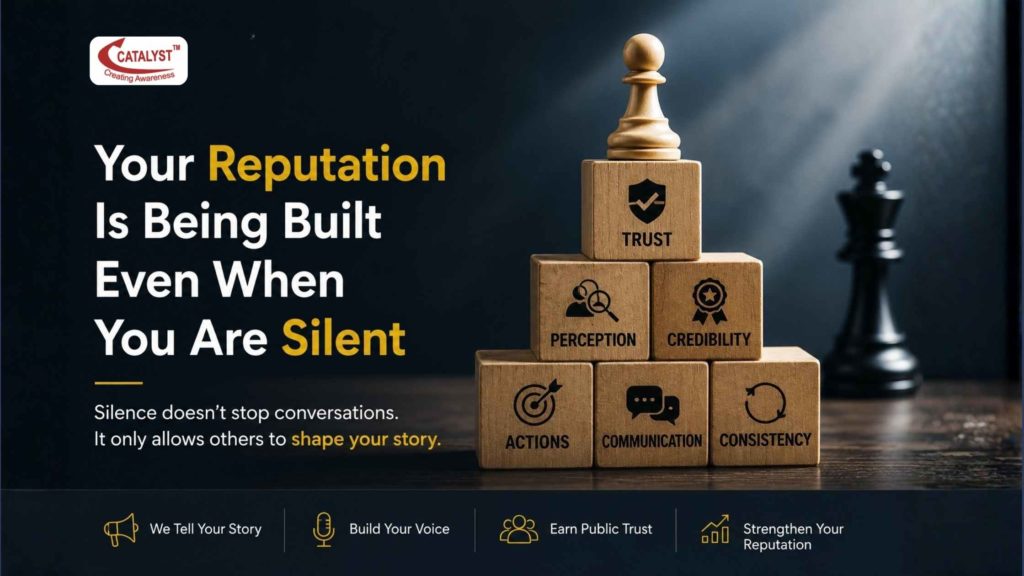
Your reputation is being built even when you are silent.
Silence Is Also Communication
Imagine meeting someone for the first time.
You ask them a question. They give a one-word answer.
You try to have a conversation. They reveal very little about themselves.
You don’t hear from them again for several months.
Naturally, you’ll begin forming opinions.
You may assume they are uninterested, reserved, unapproachable, or perhaps even arrogant.
Whether those assumptions are correct or not almost doesn’t matter.
An impression has already been created.
Businesses are no different.
People form opinions based on what they see, what they don’t see, and the information available to them.
A company that rarely communicates isn’t perceived as a company without information.
It’s perceived as a company that people know very little about.
And in the absence of information, people often fill the gaps with assumptions.
The Market Doesn’t Like Empty Spaces
Think about how people evaluate businesses today.
Before becoming customers, they visit websites.
They search online.
They browse social media pages.
They look for reviews.
Sometimes they even search for the founder behind the business.
What happens when they find very little?
Questions begin to emerge.
Is the business active?
Is it growing?
Is it trustworthy?
Does it still exist?
Again, these questions may have nothing to do with reality.
But perception doesn’t wait for explanations.
It starts forming immediately.
The marketplace dislikes empty spaces. Whenever information is missing, assumptions move in to occupy it.
Good Businesses Often Stay Quiet
Interestingly, many excellent businesses unintentionally become invisible.
They are busy serving customers.
They are focused on operations.
They are solving problems and improving their products.
Communication becomes an afterthought.
“We’re too busy for social media.”
“We don’t want to promote ourselves.”
“Our work should speak for itself.”
These statements are understandable.
But in today’s world, good work and communication are not competitors.
They are partners.
Doing great work creates value.
Communicating it creates visibility.
Visibility creates trust.
Reputation Is Built Long Before It’s Needed
One of the biggest misconceptions about reputation management is that it becomes important only during difficult times.
In reality, reputation is built quietly over months and years.
It grows through consistency.
A founder sharing industry insights.
A company celebrating milestones.
A team highlighting customer success stories.
A business participating in conversations that matter to its industry.
None of these activities feel dramatic.
Yet together, they gradually answer an important question in people’s minds:
“Who are you?”
The businesses that consistently communicate don’t necessarily have better products.
But they often have stronger familiarity and trust.
People naturally feel more comfortable with businesses they know something about.
Silence Doesn’t Mean Neutrality
Many businesses assume silence is a neutral position.
It isn’t.
Silence still communicates.
An inactive website communicates.
An abandoned social media page communicates.
A founder who never shares insights communicates.
A company that never tells its story communicates.
The message may not be the one you intended, but a message is being received nonetheless.
The question is not whether people are forming opinions.
The question is whether you’re participating in shaping those opinions.
The Most Valuable Stories Are Often Untold
Every business has stories worth sharing.
The problem is that founders often underestimate their own experiences.
The customer challenge they solved.
The lesson learned after a difficult year.
The values that shaped the company.
The idea that inspired the business in the first place.
These stories may feel ordinary to the founder.
To others, they build credibility.
People don’t connect with logos and brochures.
They connect with people, journeys, and ideas.
When businesses remain silent, these opportunities to build trust simply go unused.
Final Thoughts
Your reputation isn’t created only during media interviews or moments of crisis.
It’s being shaped every day.
Through what you say.
Through what you share.
Through how consistently you communicate.
And yes, even through your silence.
The reality is that people are already forming opinions about your business. Customers are evaluating you. Prospective employees are researching you. Partners are observing you.
The conversation is happening whether you participate or not.
The good news is that reputation isn’t reserved for large corporations with enormous marketing budgets.
It is built through small, consistent acts of communication over time.
Because in business, silence doesn’t prevent your reputation from being built.
It simply means you have less control over who builds it.
At Catalyst PR, we help businesses and founders actively shape their reputation through strategic communication, founder branding, media relations, and thought leadership—because your story deserves to be told by you, not by assumptions.